
How Much Will I Actually Walk Away With When I Sell My Home?
Selling your home for $500,000, $600,000, or $700,000 can sound great on paper.
But the sales price is not the same thing as the amount you actually keep.
What matters is your estimated net proceeds — what may be left after your mortgage payoff, negotiated compensation, closing costs, concessions, repairs, taxes, and other transaction-related expenses.
That is why I think sellers should understand their estimated bottom line before making major decisions around a move.
If you are thinking about selling in Tooele County, Stansbury Park, Grantsville, or elsewhere in Utah, a seller net sheet can help give you a much clearer picture of what selling may actually look like financially.
What Are Seller Net Proceeds?
Seller net proceeds are an estimate of the amount you may receive after the sale once applicable obligations and expenses are accounted for.
A simplified version looks like this:
Sale Price
– Mortgage Payoff
– Estimated Selling Expenses
– Negotiated Concessions or Credits
– Other Applicable Costs
= Estimated Net Proceeds
Every transaction is different, so this is not a guaranteed number.
But it is much more useful than simply looking at your expected sales price and assuming that is what you will have available for your next move.
A Simple Example
Let’s use completely hypothetical numbers.
Imagine your home sells for:
$600,000
And your approximate mortgage payoff is:
$350,000
At first glance, you might think:
$600,000 – $350,000 = $250,000
But that $250,000 would still be before other selling expenses.
For illustration, imagine the transaction has another:
$43,000 in estimated costs
Those costs might include things such as negotiated real estate compensation, closing or title-related expenses, seller concessions, taxes or prorations, and other transaction-specific costs.
The simplified example would look like this:
$600,000 sale price
– $350,000 mortgage payoff
– $43,000 estimated selling costs
= $207,000 estimated net proceeds
Again, this is only a hypothetical example.
Your actual numbers could be very different.
The purpose is to show why the headline sales price does not tell the whole story.
Why Your Mortgage Payoff Matters
One of the biggest pieces of your net sheet is your mortgage payoff.
That number may be slightly different from the balance you see when you log into your mortgage account.
The final payoff amount can include interest through the payoff date or other lender-specific amounts, so the appropriate payoff will ultimately come from the lender or title/settlement professionals handling the transaction.
For early planning purposes, though, an approximate balance can still help us build a useful estimate.
This can be especially important if your next move depends on the proceeds from the sale.
For example, you may be asking:
- Will I have enough for the down payment on my next home?
- How much cash may I have available after closing?
- Can I afford to move before I buy again?
- Does selling now support my financial goals?
Those questions are easier to answer when you are looking at estimated net proceeds instead of just the sales price.
What Selling Costs Should You Expect?
There is no one-size-fits-all answer.
Selling costs vary based on the property, contract, negotiated terms, and transaction.
Potential expenses may include:
- Negotiated real estate compensation
- Title and settlement-related costs
- Taxes and prorations
- Seller-paid buyer concessions
- Agreed-upon repairs or credits
- HOA-related charges, if applicable
- Mortgage payoff
- Other transaction-specific expenses
Some of these costs may be known before your home is listed.
Others may depend on the offer you accept or what happens during inspections and negotiations.
That is why I view a seller net sheet as a planning tool, not a financial guarantee.
Why the Highest Offer Is Not Always the Best Offer
This is one of the biggest reasons I like sellers to think in terms of net proceeds.
Imagine you receive two offers.
Offer A is:
$600,000
Offer B is:
$592,000
At first glance, Offer A looks better.
But what if the $600,000 offer includes significantly more seller-paid concessions, credits, or other costs?
The lower-priced offer could potentially leave you with more money in the end.
That is why I do not think sellers should automatically choose the highest number on the page.
You have to look at the entire offer.
That can include:
- Purchase price
- Concessions
- Financing
- Contingencies
- Closing timeline
- Repair requests
- Other negotiated terms
- Estimated proceeds
The better question is:
Which offer gives you the strongest overall outcome?
Your Bottom Line Should Matter Before You List
Seller net proceeds are not just something to think about after an offer comes in.
They can also help before you ever put your home on the market.
If you need a certain amount from the sale in order to buy your next home, relocate, pay off debt, or make another financial move, that matters.
But there is an important distinction between:
what you need from the sale
and
what the market supports as the value of your home.
Those are not always the same number.
My approach is to look at comparable sales, current competition, market activity, and your property itself to develop a realistic pricing range.
I would rather have an honest conversation about that before you list than build a plan around a number the market may not support.
That is part of protecting your bottom line too.
Pricing Is Not a One-Time Decision
Another thing sellers sometimes assume is that the pricing conversation ends once the home goes live.
I do not look at it that way.
Once the property is listed, the market starts giving us new information.
That may include:
- Showing activity
- Buyer feedback
- New competing listings
- Homes going under contract
- Price reductions
- Relevant closed sales
- Open house activity
That information matters.
If the market is responding well, we may stay the course.
If it is not, then we need to understand why.
The goal is not to make random price changes.
The goal is to listen to what the market is telling us and make informed decisions.
Should You Get a Seller Net Sheet Before Listing?
In many cases, yes.
Especially if your next move depends heavily on your proceeds.
A seller net sheet can help you think through questions like:
How much might I actually walk away with?
What happens if I accept a lower offer?
How much could concessions affect my proceeds?
Will I have enough money for the next house?
Does selling now make sense financially?
You do not need to be ready to list tomorrow to start looking at these numbers.
Sometimes the most useful first step is simply understanding your options.
Frequently Asked Questions
Is a seller net sheet guaranteed?
No.
A seller net sheet is an estimate based on the information available at the time.
Final proceeds can change based on the actual sales price, mortgage payoff, negotiated compensation, concessions, repairs, taxes, prorations, closing expenses, and other transaction details.
Do I need my exact mortgage payoff?
Not necessarily for an early estimate.
An approximate balance can help create a starting point.
The final payoff amount will need to be confirmed for the actual closing.
Does the highest offer always mean more money for me?
No.
A higher offer with large concessions or additional seller-paid costs could potentially produce a lower net than a slightly lower offer with stronger terms.
That is why it is important to compare the full offer, not just the purchase price.
Can I know exactly what my home will sell for?
No one can guarantee an exact sales price before the market responds.
A comparative market analysis can help establish a reasonable pricing range based on comparable sales, current competition, property condition, and market activity.
Do I have to be ready to sell to get a net sheet?
No.
A net sheet can simply be a planning tool.
If you are trying to figure out whether selling makes sense, it can be helpful to understand the estimated numbers first.
Thinking About Selling?
If you are considering selling in Tooele County or elsewhere in Utah, I can put together a personalized estimated seller net sheet based on your property, approximate mortgage payoff, and a realistic potential sales range.
There are no guarantees about what you will ultimately receive at closing.
The goal is simply to give you a clearer picture of your potential bottom line so you can make a more informed decision.
If you want an estimated seller net sheet, reach out and ask for a NET estimate.
FROM OUR BLOG

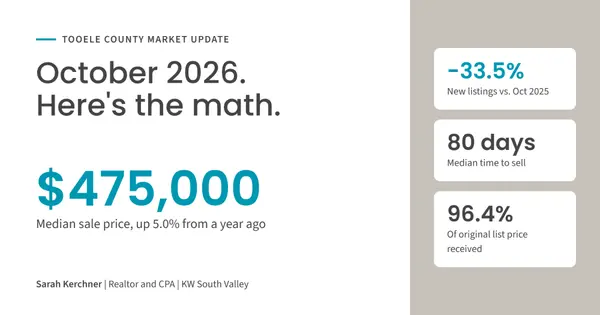
Tooele County Housing Market Update: October 2026
Realtor and CPA here. Every month I pull the Tooele County numbers so you don't have to. Here's what happened in October 2026, and what it means if you're thinking about selling. The short version: prices went up, but a lot fewer people listed, and homes are taking almost three months to sell. Price

November 2026 Events in Salt Lake County, Utah
November 2026 Events in Salt Lake County, Utah Looking for things to do in Salt Lake County this November? From holiday markets and festive light displays to live entertainment and family-friendly activities, there's plenty happening throughout the valley! Here's your guide to November 2026 events i

November 2026 Events in Tooele County, Utah
November 2026 Events in Tooele County, Utah Looking for things to do in Tooele County this November? From holiday markets and live entertainment to family activities and local workshops, there's plenty happening around town! Here's your guide to November 2026 events in Tooele County. November 5–14 N