
What Should You Look at Before Making an Offer on a Home?
Buying a home can get emotional fast.
You walk into a house, love the kitchen, picture your furniture in the living room, and suddenly you’re asking:
“What should we offer?”
Before you get there, I think it helps to slow down and look at the full picture.
A home is more than the finishes you see during a showing. There are questions about value, condition, monthly payment, future repair costs, seller motivation, and how well the home actually fits your life.
If you’re buying in Tooele County, Stansbury Park, Grantsville, or elsewhere in Utah, here are some of the things I think are worth looking at before you make an offer.
Start With What You Actually Need From the Home
Before deciding whether a home is “the one,” ask whether it actually supports what you’re trying to accomplish.
That can include questions like:
- How long do you expect to live there?
- Do you need room to grow?
- Does the layout work for your daily life?
- How important is the yard or lot size?
- How does the commute fit your routine?
- Are you comfortable with an HOA?
- Are there features you truly need versus things that would simply be nice to have?
This is one reason I don’t think home shopping should just be a series of random showings.
Sometimes buyers start out thinking they want one thing and realize after seeing several homes that something completely different matters more.
If the first five or six homes aren’t working, that doesn’t necessarily mean the search is failing.
It may mean we’re learning.
The better question becomes:
What did you like, what did you dislike, and what should we change about the search?
That helps turn showings into useful information instead of just appointments.
Look Beyond the Pretty Parts
Fresh paint, updated countertops, and beautiful staging can make a home feel exciting.
But those are not the only things worth paying attention to.
I also want buyers thinking about the parts of the home that could affect them financially later.
That may include:
- Roof age
- HVAC age
- Water heater
- Visible signs of moisture
- Foundation or structural concerns
- Plumbing or electrical issues
- Finished spaces or additions
- HOA costs and restrictions
- Upcoming maintenance needs
I am not an inspector, contractor, roofer, or plumber.
But if something stands out during a showing, I don’t think the right approach is to ignore it and say, “We’ll worry about that during inspection.”
Sometimes there are questions we can start asking before the offer is ever written.
If the HVAC appears very old, we can ask about it.
If the roof looks like it may be nearing the end of its useful life, we can ask when it was last replaced.
If something appears unusual about a finished basement or addition, it may be worth investigating further.
Not every question will have a clear answer before you make an offer.
But the inspection should not necessarily be the first time obvious questions are being asked.
Understand What the Home May Actually Be Worth
Once you love a home, it can be tempting to focus only on the list price.
But the list price is not automatically the market value.
Before deciding what to offer, I like to look at the broader picture.
That may include:
- Similar homes that recently sold
- Current competing listings
- Days on market
- Price reductions
- Property condition
- Recent concessions where available
- Overall market activity
The goal is not to find one magical number.
It is to understand where the home appears to sit within the market so you can make a more informed decision.
If a home is listed at $500,000 but similar homes have recently sold for significantly less, that is important information.
You may still decide the home is worth paying more for because of its location, condition, features, or your own priorities.
But I think that should be a conscious choice, not an emotional guess.
Find Out What Matters to the Seller
Negotiation does not always mean offering more money.
Before assuming the only way to make an offer stronger is to increase the price, I like to understand as much as reasonably possible about what matters to the seller.
That could include:
- Preferred closing date
- Whether they have already moved
- Whether timing is important
- Whether they are looking for fewer concessions
- Whether certainty matters
- Whether there are possession considerations
- Whether certain terms may be more valuable than a slightly higher price
The listing agent may not disclose everything.
That is normal.
But it is still worth asking.
Sometimes buyers can make a stronger offer by solving a seller’s problem instead of simply paying more.
That is why I prefer to gather context first and negotiate second.
Compare the Financial Options, Not Just the Purchase Price
This is one area where I naturally spend a lot of time with buyers.
I’m a CPA with an accounting background, so I tend to look closely at the financial tradeoffs involved in a purchase.
That does not mean I replace your lender.
Your lender should be the one providing mortgage-specific calculations, payment information, and loan guidance.
But if there are multiple options on the table, I want you to understand the difference between them.
For example, if a seller is willing to give value through a negotiation, that value could potentially be used in different ways depending on the transaction.
It may involve:
- Closing-cost assistance
- A potential rate buydown
- Repairs
- A purchase-price reduction
- Another negotiated solution
The best option depends on the buyer.
A $15,000 purchase-price reduction does not necessarily have the same impact as having a $15,000 major repair handled before closing.
For a buyer who wants to preserve cash after closing, that difference can matter.
That is why I like to involve the lender and compare actual scenarios such as:
- Monthly payment
- Cash needed to close
- Purchase price
- Amount financed
- Cash remaining after closing
- Near-term repair costs
The goal is not just to negotiate something.
It is to understand which option actually helps you the most.
Think About Future Costs Before You Fall in Love
One of the biggest mistakes buyers can make is focusing only on whether they can afford the purchase.
There is also the question of what happens after closing.
A home may fit your purchase budget but still create financial pressure if several major systems are nearing replacement.
That does not automatically mean you should walk away.
It just means you should understand what you are taking on.
For example, if you know a roof may need replacement relatively soon, that could affect:
- How much you offer
- Whether you request a repair or concession
- How much cash you want to keep in reserves
- Whether that home still makes sense compared with another option
Buying a home should not require predicting every future expense.
But obvious near-term costs should be part of the decision.
Know What Protections You Are Giving Up
In competitive situations, buyers are sometimes tempted to weaken contingencies or protections to make their offer more attractive.
That can include changes to inspection, appraisal, financing, or other contract terms.
There may be circumstances where buyers choose to do that.
But I think the important part is understanding the tradeoff.
A stronger offer is not automatically a better offer if it exposes you to a level of risk you are not comfortable with.
Before changing protections, understand:
What are you gaining?
And what are you potentially giving up?
Then make the decision intentionally.
Think About the Home as Life Fit, Property Fit, and Financial Fit
When buyers are deciding between two or three homes, I like to think about the comparison in three categories.
Life Fit
Does the home support the life you expect to live?
Think about layout, future plans, commute, space, and how long you may stay there.
Property Fit
What are you actually buying?
Consider condition, lot, major systems, maintenance, features, HOA, and potential repair exposure.
Financial Fit
How does the home affect you financially?
Look at payment, purchase price, cash to close, HOA costs, upcoming expenses, and other costs that matter to your situation.
The prettiest house is not always the best house.
The better home is usually the one that makes the most sense across all three.
Frequently Asked Questions
Should I get pre-approved before looking at homes?
In most cases, yes. A pre-approval can help you better understand your potential budget and makes it easier to evaluate homes within a realistic financial range. Your lender can explain the specific loan requirements and what you may qualify for.
Should I always offer below asking price?
No. The right offer strategy depends on the home, comparable sales, current market conditions, days on market, seller priorities, competition, and your own goals.
Should I waive the inspection to make my offer stronger?
That depends on the situation and your comfort with the risk. Waiving or limiting inspection protections can increase your exposure to unknown property issues. Make sure you understand that risk before making the decision.
What happens if the appraisal comes in low?
The options depend on your contract and financing terms. The seller may agree to reduce the price, the buyer may choose to cover part of the difference, the parties may compromise, or the transaction may have other outcomes depending on the contract.
Is a lower purchase price always better than seller concessions?
Not necessarily. It depends on your financial situation and loan structure. Sometimes closing-cost assistance, repairs, or another negotiated option may create more immediate value. Your lender can help compare the actual numbers.
Thinking About Buying in Tooele County or Utah?
If you are thinking about buying a home, you do not have to start by immediately touring houses.
Sometimes the better first step is understanding your goals, your budget, what you should be looking for, and how the buying process works.
My approach is to help buyers understand the home, understand the numbers, and make the decision with as much information as possible.
If you are considering buying in Tooele County, Stansbury Park, Grantsville, or elsewhere in Utah, I am happy to sit down with you for a low-pressure buyer consultation and walk through the process before you start seriously shopping.
Reach out if you’d like to schedule a buyer consultation.
FROM OUR BLOG
Tooele County Housing Market Update: October 2026
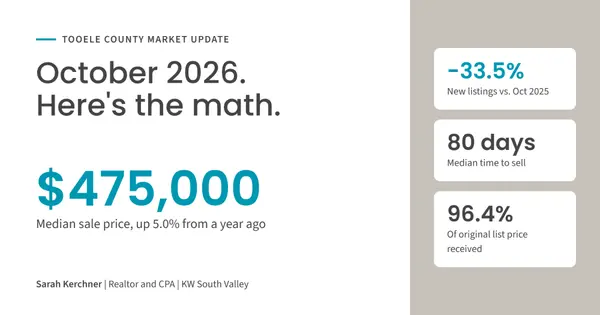
Realtor and CPA here. Every month I pull the Tooele County numbers so you don't have to. Here's what happened in October 2026, and what it means if you're thinking about selling. The short version: prices went up, but a lot fewer people listed, and homes are taking almost three months to sell. Price

November 2026 Events in Salt Lake County, Utah
November 2026 Events in Salt Lake County, Utah Looking for things to do in Salt Lake County this November? From holiday markets and festive light displays to live entertainment and family-friendly activities, there's plenty happening throughout the valley! Here's your guide to November 2026 events i

November 2026 Events in Tooele County, Utah
November 2026 Events in Tooele County, Utah Looking for things to do in Tooele County this November? From holiday markets and live entertainment to family activities and local workshops, there's plenty happening around town! Here's your guide to November 2026 events in Tooele County. November 5–14 N